
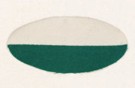
36th Battalion Colour Patch (photo AWM)
Henry Shumack 2877 together with his sons, Aiden Sylvester Shumack 2876 and Harold Gordon Shumack 2911 enlisted at Bathurst on September 25, 1916. They were farmers from Tooraweenah, NSW and trained at Bathurst and Liverpool before embarking on the ‘Beltana’ on November 25, 1916 with the 36th Battalion. After further training at the 9th Training Battalion in Durrington, England they arrived in France to join the 36th Battalions first major battle at Messines.
Private Henry Shumack 2877 was 40 years old when he enlisted, his wife Florence Shumack was his next of kin. His medical examination describes him as 5’7” tall, 172 lbs (78kgs), chest expansion 40”/41 ½”, dark complexion, grey eyes, dark hair and no distinctive marks. He was Presbyterian. Henrys 1st wife, the mother of the boys, had died and Henry had married Florence in 1914, they had only been married 2 years when her husband and two step-sons left for the war.
Private Aiden Sylvester Shumack 2876 stated his age as 18 years old, his step mother, Florence Elizabeth was his next of kin. His medical examination described him as 5’8” tall, 150lbs (68kgs), chest expansion 34 ½” – 37”, dark complexion, brown eyes, brown hair with large scar neat right elbow and upper arm. His religion was Presbyterian.
Private Harold Gordon Shumack 2911 stated his age as 20 years old, his step mother Florence Elizabeth as his next of kin. His medical examination describes him as 5’7” tall, 140lbs (63kgs), dark complexion, brown eyes, dark hair, and a scar outer side right leg. He was Presbyterian.
Henry wrote to his mother in Tooraweenah about how much he enjoyed his visit to the Tower of London. He said.’ the English Tommies are fine fellows and seem very fond of the Australians’. Tobacco was dear and petrol rationing was for war work only. The letter was printed in the Gilgandra Weekly on June 15 1917. Henry and his sons arrived in France together to join their unit, the 36th Battalion on July 10, 1917.
Five days later on July 15 1917, Henry was killed by a shell. The Red Cross Missing and Wounded reports state that he was killed with 4 others. In his report, Private L Fradd 5137 stated he stopped Henry’s sons from going to see the bodies, he took them to the doctor and had them sent to the Rest Stations. One report stated that Henry was the batman of Captain Fitzhardinge, Officer Commanding of B Company. Captain Fitzhardinge was a solicitor from Gilgandra and had written to the family, but the correspondence was lost at sea. He was nearby when Henry and four others were killed when a shell hit the dugout in an old dressing station near Messines, on the Neuve Eglise Road. They were buried and crosses put on their graves. Henry is buried at Kandahar Cemetery, Belgium, and commemorated on the Australian War Memorial Panel number 127, the Gilgandra War Memorial and the Tooraweenah War Memorial. Henry, Harold and Aiden are also commemorated on the Gilgandra Services Wall.
The Gilgandra Weekly reported on August 24 1917, ‘an impressive service was held at the Tooraweenah Church…to the memory of Private hey Shumack, who gave his life for his country. The Reverend WH Butler officiated and preached to a very large congregation.’
On October 8 1917the Gilgandra Weekly printed the letter that was written by Harold Shumack to his step-mother, Florence. ‘War has claimed its first victim from us. It is awful news, Poor father was killed yesterday, I suppose you will have heard long before you get this though. There is one consolation I have that is he suffered no pain or agony, for it was concussion of a shell that killed him and he was gone in a moment. I was quite close to the spot. He died as only Australians can die, brave and true to the last. It was a terrible bombardment in which he was killed. It lasted for three hours. The air shook the ground on which we were standing and the noise was terrific. I got shell shock and how I escaped from being killed the Lord above me only knows. Aiden was hit on the shoulder with a block of wood but was only bruised. I am going to the hospital for my nerves are dreadfully shaken and I have a touch of gas. Aiden is still in the line. He is as hard as iron and afraid of nothing.’ The Australian War Memorial hold letters from the boys and their grandmother.
Harold remained in France with his unit but was admitted to hospital several times after his father was killed. On April 12, 1918 Harold was wounded in action with a gunshot wound to his back. According to the Units Diary, the 36th Battalion was north of Hangard, near Villers-Brettoneux when there was a heavy enemy barrage. A shell landed on the Battalion Headquarters killing 3 officers and 6 other ranks and wounding 1 officer and 3 other ranks. He was invalided out to England and did not return to France. On March 16 1919, Harold was charged with being in Bath without a pass and forfeited 5 days pay. But he had embarked for Australia on the Hospital Ship ‘Khyber’, disembarking in Sydney on May 16 1919. By the time the authorities caught up with him, he had returned home to Australia. He later lived at Bankstown and died March 21 1987.
Aiden had several admissions to hospital but he remained in France until he was granted leave to the UK in December 1918. He must have enjoyed his leave because he had not reported back and was apprehended on January 9 1919 and sent to Lewes Detention Barracks for 90 days. Aiden commenced his return to Australia on June 12 1919 on the ‘Port Darwin”, and arrived in Melbourne on July 27 1919 and was discharged at Sydney NSW. Aiden never married, died December 6 1957 and is buried in Gilgandra Cemetery in the Anglican section; row Q/028.
Henry, Harold and Aiden were issued the Victory Medal and the British War Medal
After the war, Florence requested a copy of the cemetery register. She had remarried and was now Mrs F Taylor of Beveridges Farm, ‘Tuglands”, Gilgandra
Written for Tracey Stevenson and her mother, Mary Stevenson by Margo Piggott 2016