
Collie NSW
1637
45th Battalion,
Tooraweenah Kookaburra
RTA 8.4.1917
Patrick and Michael O ‘Connor joined the Tooraweenah Recruitment March on 12 January 1916 and marched 378 kms to Bathurst. Their story cannot be told without including their brother, George O’Connor, who joined them soon after they arrived at Bathurst. A fourth brother, Edmund Joseph O’Connor enlisted in August 1917, aged just 19years old and is also part of their story.
Mrs Caroline O’Connor of Collie NSW saw four of her sons enlist in World War One and march away to endure the hardships of the Western Front. Only three returned to Australia. The boys were single and worked on the family farm at Collie NSW. Their mother was their next of kin as their father; William O’Connor had died in 1913.
Patrick, Michael and George trained at Bathurst until 29 March 1916 and embarked for Egypt on the ‘Ceramic’ on 14 April, 1916. With the 45th Battalion. After training in Egypt, they embarked at Alexandria on the ‘Francona’ and arrived at Plymouth England, on 16 June 1916. They left for France on 9 September 1916 and joined their unit, the 45th Battalion on 20 September 1916 in Belgium.
—————
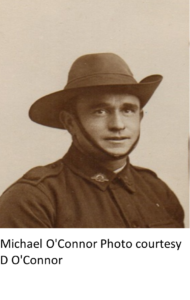
Michael was a 28 year old farmer of Collie NSW when he enlisted on 12 January, 1916 at Tooraweenah and joined the Kookaburra Recruitment March to Bathurst, 378kms away. Michael had served with the local 9th Light Horse CMF in Gilgandra NSW.
The medical examination described him as 5’ 4 1/2” tall, 165 lbs (74.8kgs), chest expansion 36”-40”, fair complexion, blue eyes, brown hair, religion Roman Catholic and no distinguishing marks.
Michael kept a diary while he was away, recording short observations of the people he met and the places he saw. They trained at Bathurst, drilling and playing cricket against St Stanislaus School. They had final leave at home and ‘had a good send off at Collie’. They left Bathurst on 13 April 1916 by train and had a ‘bonser’ march through Bathurst and then embarked for Egypt on the ‘Ceramic’ on 14 April, 1916. ‘A bonser sight leaving the port, a big crowd of people’. A boxing tournament helped pass the time on the ship, ‘our boys won, they were only beaten once….’ They went ashore at Columbo, Ceylon, now Sri Lanka. ‘Very pretty sight …a fine place.’ A soldier died at Colombo and they buried him at sea.
He liked the Suez Canal, ’passed by some big camps, thousands of troops and camels, splendid sights, saw a seaplane.’ Port Said was ‘a very busy place and took a boat off of our ship to the wharf. Took train to Tel el Kebir, arrived 10.30pm. had a pretty rough time, very cold night. Got half rations, very hot day, hot winds had to cart our stuff on vans and pull them ourselves.’ The introduction to Egypt was not good.
After training in Egypt they embarked at Alexandria on the ‘Francona’ and arrived at Plymouth on 16 June, 1916. Michael attended training for Non-Commissioned Officers (NCO) and reverted to Private when he joined the unit in France.
He left for France on 9 September, 1916 and joined his unit, the 45th Battalion, on 20 September 1916 in Belgium. They faced a cold, wet winter in Belgium and the Somme. Michael was sick and was sent to hospital on 22 December, 1916. His mother was notified that he was ‘dangerously ill’. In February his condition was ‘improving’ and by March he was ‘progressing favourably’. On 3 March 31917 Michael embarked on the Hospital Ship ‘St George’ at Rouen and was sent to England to be admitted to Beaufort Military Hospital at Bristol with Spinal Meningitis. After treatment and some convalescence at No 2 Command Depot, Michael was returned to Australia on 8 April, 1917 on the Hospital Ship ‘Barambah’. He was discharged on 26 July, 1917 and married Kathleen Cridland in Dubbo in 1918. Michael died 30 March, 1961 and is buried in the Old Dubbo Cemetery.
Private Michael O’Connor was issued the British War Medal and the Victory Medal. He is commemorated on the Collie War Memorial.