
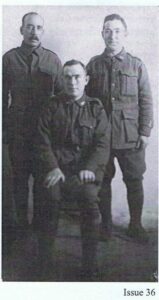
Irwin Brothers; Andrew and Leslie at rear; William sitting
Photo from Digger Magazine, Graeme Hosken
ANDREW, JAMES. LESLIE AND WILLIAM IRVIN
The four Irvin brothers lived at Tooraweenah and returned there after the war. They are commemorated on the Tooraweenah War Memorial. Henry Irvin was their father and next of kin.
IRVIN William 1893, known as Bill was a 27 year old farmer of Tooraweenah when he enlisted on 10 August 1915 in Dubbo. He was 5’ 7” tall, 136lbs, 36 ½” chest, dark complexion, greenish eyes, brown hair, and an oval scar on the back of left upper arm. William embarked from Sydney on board HMAT A60 ‘Aeneas’ on 20 December 1915 with the 6th Light Horse Regiment. While in Egypt he was in the 2nd Light Horse Reserve Regiment but soon after transferred to the 25th Howitzer Brigade and posted to the 114th Battery. He arrived in France and served with the 115th Battery and then the 3rd Artillery Brigade. William enjoyed leave in Paris and London and his only admission to hospital was with influenza. He was with his battery when Armistice was declared and he returned to Australia on 20 April 1919 on board HMAT ‘Boonah’. Driver William Irvin was discharged 3 August 1919.
William, James and Rufus were granted Soldier Settlement blocks on the Eumungerie Rd, outside of Gilgandra. William later moved to Victoria and remained there the rest of his life.
ANDREW, JAMES AND LESLIE
James, Andrew and Leslie Irvin enlisted together on 17 January 1916 at the Sydney Town Hall Recruiting Centre. They were all Presbyterian and all noted their father, Henry Irvin of Tooraweenah as their next of kin. Tooraweenah gave them a farewell and presented them with gifts which included a balaclava, socks, wristlet watch and a fountain pen. They embarked from Sydney on board HMAT A55 ‘Kyarra on 3 June 1916 with 18th Reinforcement of the 3rd Battalion. They arrived in Plymouth 3 August 1916 and joined the unit in Belgium on 6 October 1916.
IRVIN Andrew 5688. Andrew, better known as Andy, was a 29 year old labourer of Tooraweenah. He was 5’ 6” tall, 1129lbs (58.5 kgs), fresh complexion, blue eyes, brown hair and no distinctive marks. Andrew was admitted to hospital with mumps shortly arriving in France and joined his brothers in the 3rd Battalion on 31 October 1916. When the 3rd Battalion was fighting the Second Battle of Bullecourt Andrew was wounded in action on 5 May 1917 with a gunshot wound to the right arm and leg. He was treated in France and rejoined his unit on 4 June 1917. From 4 September he attended an Infantry Brigade School in France and then had three weeks leave in the UK. He rejoined his unit in mid-November to face a freezing winter. On 14 April 1918, when the battalion was fighting around Strazeele, Andy was wounded in action with shrapnel wound to the right leg. He was sent to England for treatment and convalescence. While in England he attended the Machine Gun Depot at Parkhouse on 21st October 1918. Armistice was declared on the 11 November and Andrew did not return to France. He commenced his journey home on 19 February 1919. He arrived in Sydney on 3 April and was discharged 17 June 1919.
Private Andrew Irvin was issued the British War Medal and the Victory Medal. He served in Dubbo during WW2. He died 3 May 1959 and is buried in the Gilgandra Cemetery.
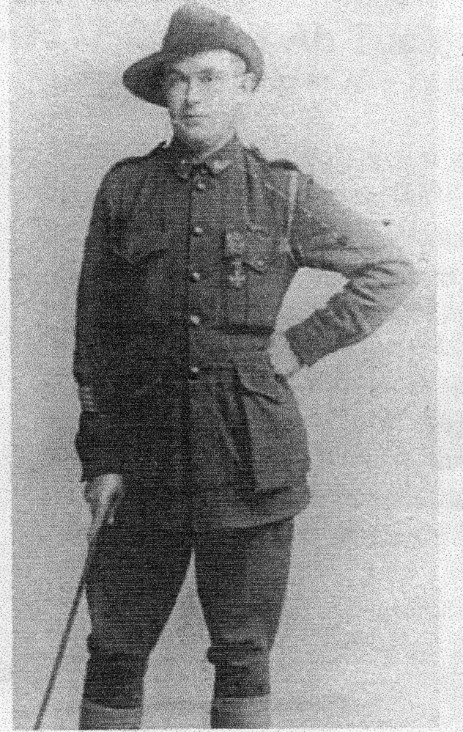
IRVIN James 5686,
James Irvin, better known as Jim, was a 25 year old farmer, 5’8” tall, 143 lbs, fresh complexion, grey eyes and black hair. James was appointed Lance Corporal in May 1917. When he was with his brother Leslie, (better known as Rufus) in an observation post near Passchendaele, James was wounded in action. He was hit with shrapnel to his face and left hand on 10 November 1917. He rejoined the unit 30 November 1917 and was awarded the Belgian Croix de Guerre for
‘Conspicuous bravery and devotion to duty. Pte Irvin is a Lewis gunner and has always set an excellent example to all by his capable employment of his gun in action. At Lihons and Hargicourt he displayed great initiative and boldness, and by his excellent services aided considerably in the capture of the objective allotted to his Company, as well as inflicting severe casualties on the enemy.’
James returned to Australia on HMAT ‘Aeneas’ 12 July 1919. He was issued the British War Medal and the Victory Medal. He died 17 May 1960 and is buried in the Gilgandra Cemetery
IRVIN Leslie 4687. Leslie, better known as Rufus was a 22 year old farmer from Tooraweenah. He was 5’ 5” tall, 145 lbs (66kgs), 32”-36” chest, blue eyes good vision, fresh complexion, brown hair and no distinctive marks noted. Leslie joined his unit in October in Belgium. He was wounded in action with a gunshot wound to the right leg near Hermies on 9 April 1917. He was treated in France and re-joined the unit on 18 May 1917.
On 10 November 1917 he was with his brother, James in an observation post near Passchendaele when it was hit with a shell. Leslie was unhurt but Jack Ison of Dubbo was killed and James was wounded. Leslie had leave in the UK over Christmas and New Year with his brother, James. In September 1918 Leslie was wounded in action for the second time with gunshot wounds to his back and left hip. He was sent to England for treatment and convalescence. He remained in the UK until he left for home on 14 January 1919 on board the ship ‘City of York’. Leslie was discharged 12 April 1919 and issued the British War Medal and the Victory Medal.
He died 13 February 1964 and is buried in the Gilgandra Cemetery.
In about 1920 the property around ‘Hillside’ was divided into Soldier Settlement blocks. The Irvin brothers, William, James and Leslie (Rufus) all drew blocks. Leslie’s son, Roger Irvin, lived on ‘Hillside ‘until about 2024. Roger’s neighbour, John White is the son of original soldier settler, Tom White. Roger and John recently replaced the boundary fence built by their fathers, nearly one hundred years ago.