
Hornsby, NSW
1887
13th Battalion, 60th Battalion
Gilgandra Coo-ee
Died of Disease 23.8.1916
Private Frank Humphrey 1887
Frank was a 33 year old bricklayer from Albert St Hornsby NSW when he enlisted in Gilgandra on 9 October 1915. The medical examination described him as 5’ 4” tall, weight 136lbs (61kgs), dark complexion, greenish eyes and brown hair. His religion was Church of England. He stated his previous service was seven months with Roystons Horse in South Africa during the Zulu Rebellion.
He marched to Sydney with the Coo-ees and trained at Liverpool Camp with the 13th Battalion. However he was discharged on 4 January 1916 after being absent without leave for the second time. He re-enlisted on 11 February 1916 at Wangaratta, Victoria with the 60th Battalion. His next of kin was his mother, Matilda Johnstone, 31 Thorsley St, Princess Avenue, Hull, England. On 1 May 1916 he embarked for Egypt from Melbourne aboard the Port Lincoln, arriving on 10 June . He was admitted to the No 2 Australian General Hospital with an illness, leaving a week later for France aboard the transport Franconia.
After arriving in Le Havre, France, Frank was admitted to the Canadian General Hospital and died of disease on 23 August 1916.
The only active service seen by Frank was in South Africa. He is buried in the Ste. Marie Cemetery Le Havre. His mother received the British Medal and the Memorial Scroll.
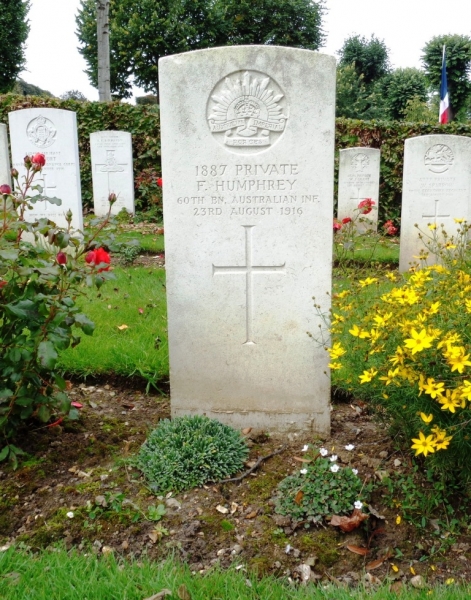
Frank Humphrey’s headstone at Ste. Marie Cemetery, Le Havre, France (Photograph: H. Thompson 2/9/2014)
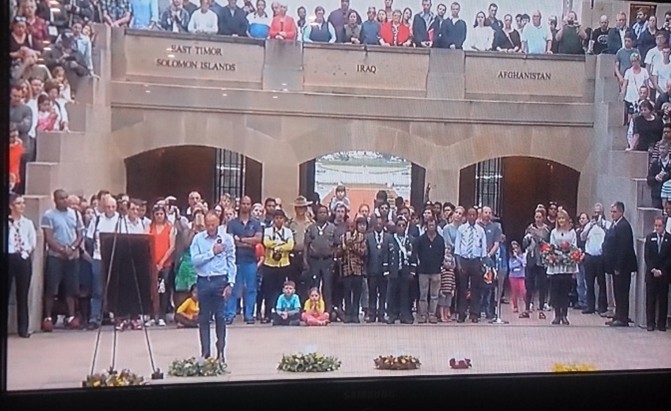
Morrie Butler lays a wreath for Frank Humphrey at the last Post Ceremony 23 April 2026
Speech transcript
1887 Private Frank Humphrey, 60th Battalion, AIF
DOD 23 August 1916
Story delivered 23 April 2017
Today we remember and pay tribute to Private Frank Humphrey.
Born in Hull in Yorkshire in England, Frank Humphrey was 33 years old and working as bricklayer when he joined the Coo-ee recruiting march to Sydney from Gilgandra.
Under the leadership of “Captain Bill” Hitchen, 20 or so men who had determined to enlist set off on what was known as a “snowball march”. Gathering other recruits along the way, they numbered about 300 by the time they reached their destination. Humphrey had previously served for seven months in the Boer War, and was one of the first men to join the march, enlisting in early October 1915.
Humphrey went into camp at Liverpool in Sydney. However, at the start of January, he was discharged, having struggled with military discipline. His service record contains a note saying he was “not likely to become an efficient soldier”.
Humphrey then travelled to Victoria and enlisted at Wangaratta, in February 1916. He was first assigned to the 37th Battalion, but then became part of the 60th Battalion.
The 60th Battalion was raised in Egypt in February 1916 as part of the expansion of the AIF. Half of its recruits were Gallipoli veterans from the 8th Battalion, and the other half were fresh reinforcements from Australia. The majority of both groups were Victorians. The new battalion formed part of the 15th Brigade of the 5th Australian Division.
Humphrey embarked from Melbourne on board HMAT Port Lincoln in early May 1916, and sailed to Egypt. He became ill about a month after arriving, but was fit enough to embark for France on 2 August.
Humphrey became ill again and was admitted to hospital on 19 August. He died of dysentery on 23 August. He was buried in the Sainte Marie Cemetery in Le Havre, France.
Private Humphrey’s name is listed on the Roll of Honour on my right, among more than 60,000 Australians who died while serving in the First World War.
This is but one of the many stories of service and sacrifice told here at the Australian War Memorial. We now remember Private Frank Humphrey, who gave his life for us, for our freedoms, and in the hope of a better world.
Emma Campbell Researcher, Military History Section