
Collie NSW
TBC
TBC
Tooraweenah Kookaburra
RTA 1917
Patrick and Michael O ‘Connor joined the Tooraweenah Recruitment March on 12 January 1916 and marched 378 kms to Bathurst. Their story cannot be told without including their brother, George O’Connor, who joined them soon after they arrived at Bathurst. A fourth brother, Edmund Joseph O’Connor enlisted in August 1917, aged just 19years old and is also part of their story.
Mrs Caroline O’Connor of Collie NSW saw four of her sons enlist in World War One and march away to endure the hardships of the Western Front. Only three returned to Australia. The boys were single and worked on the family farm at Collie NSW. Their mother was their next of kin as their father; William O’Connor had died in 1913.
Patrick, Michael and George trained at Bathurst until 29 March 1916 and embarked for Egypt on the ‘Ceramic’ on 14 April, 1916. With the 45th Battalion. After training in Egypt, they embarked at Alexandria on the ‘Francona’ and arrived at Plymouth England, on 16 June 1916. They left for France on 9 September 1916 and joined their unit, the 45th Battalion on 20 September 1916 in Belgium.
—————
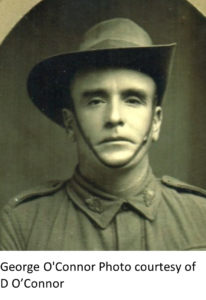
George O’Connor was a 33 year old farmer and grazier of Collie NSW, when he joined his brothers, Michael and Patrick at Bathurst NSW in February 1916. The medical examination described him as 5’83/4” tall, 170 lbs (77 kgs), chest expansion 39”-42”, ruddy complexion, brown hair and eyes with no distinctive marks. His religion was Roman Catholic.
They trained together in Bathurst, where they were assigned to the 45th Battalion and embarked for Egypt on the HMAT Ceramic on April 14, 1916.After further training in Egypt, they embarked from Alexandria to England on the ‘Francona’ arriving at Plymouth on June 16, 1916. George and his brothers left for France and joined their unit on September 20, 1916.
They faced a cold, wet winter in Belgium and at the Somme in France. George was promoted to Lance Corporal on 1 January 1917. On 3 May, 1917, George was sick with PUO, (Pyrexia of Unknown Origin), possibly Influenza, and was attended by the 13th Australian Field Ambulance and the 44 Dressing Station. He was back with his unit on 8 May, 1917 when they were behind the lines at Bresle.
One month later, on 7 June 1917, George was missing in action on the first day of the Battle of Messines. Despite an extensive search for any information about his whereabouts by the Red Cross Missing and Wounded files, he has no known grave. It is believed he was killed by a shell on the Messines Ridge, about 300 yds from the village of Messines.
A marble plaque was made by Larcombe’s in Dubbo to be sent with Edward to be placed on George’s grave, but George’s body was never identified. Unable to identify a grave the marble slab was sent back to Australia and misplaced for a period, but was found in the Victoria Army Base. It was sent back to Collie and then placed in pride of place at Collie Hall or Church and misplaced again. It was found at the family grave in Gilgandra and was displayed in Brian Bywater’s Hitchen House. It is now in the family’s possession.
The Memorial Plaque, Memorial Scroll, his British War Medal and the Victory Medal were sent to his mother, Caroline O’Connor at Collie NSW. He is commemorated on the Menin Gate Memorial in Ypres, Belgium, the Australian War Memorial Panel No.140, the Collie War Memorial and the Gilgandra Cemetery on the O’Connor family headstone.