
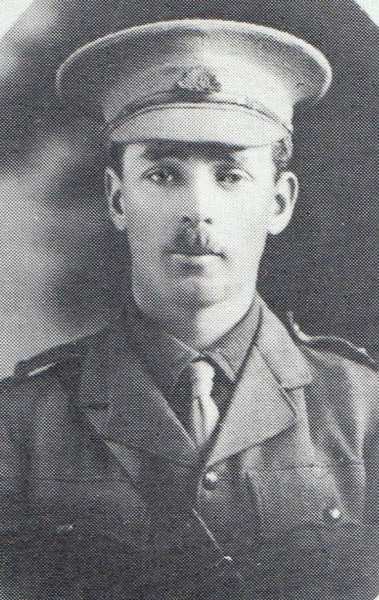
Gilgandra, NSW
Lieutenant
24th Battalion,
Gilgandra Coo-ee
RTA May 1918
2nd Lieutentant John Robert Lee
John Robert Lee was the Methodist minister in Gilgandra in 1913 to 1914. He was transferred to another Methodist Circuit but was not happy there, so had returned to Gilgandra in 1914 to take up sharefarming on ‘Eulonga’, five miles out of town.
He enlisted in Gilgandra on 9 October 1915 and joined the Cooee March to Sydney.
This was the first of the many recruiting marches organised in New South Wales.
Gilgandra local plumber and rifle club member William T Hitchen (Captain Bill) proposed a route march from Gilgandra to Sydney collecting volunteers at every town, where there would be a demonstration to secure more recruits. Despite the army officers disinterest Bill Hitchen went ahead with the help of Mr A Miller, a hairdresser of Gilgandra as secretary.
Lt Lee served as the Cooees chaplain and their leading speaker, as he was a skilled orator
Thirty five men left Gilgandra on Sunday 10th October 1915 to march to Sydney through Dubbo, Molong Orange, Bathurst, Lithgow and over the mountains through Katoomba, Penrith, Parramatta, Burwood, Ashfield and then the city of Sydney. They arrived with 265 recruits and it was the most successful of all the recruiting marches that followed.
John Robert Lee was 30 years old when he enlisted at Gilgandra and was 5’11”, weighed 10stone 7pounds (67kgs); he had a dark complexion, blue eyes and dark hair. His mother was listed as next of kin, Mrs J Sanders, Oliver Ford, Conrett, Durham,
John was born in Lancaster Durham on 19 October 1885, to coalminer James Lee and Jessie Watson. He was educated at public schools in Leadgate and Durham before attending Cliff College in Sheffield. He worked as a water works engineer for ten years and became a Methodist minister before coming to Australia in 1910, preaching at Yanco and Gilgandra.
When he marched off with the Cooees he had left the farm with 350 acres of ripening wheat. When the wheat was ripe, his neighbours moved in with 16 harvesters and horse teams and took it off, whilst others sewed the bags and carted the wheat to the silos for him.
Lt John Lee embarked from Sydney with the 24th Battalion 30 October 1916 on the “Argyllshire” and disembarked at Devonport on 10 January 1917.
On 14 January 1917 John Lee marched in to Larkhill. Following a period of training, he left from Tidsworth, England, to Etaples, France and was taken on strength 23 March 1917. The Battalion got little rest during the bleak winter of 1916-17 alternating between the front and labouring tasks. When patrolling no-man’s land, the men of the 24th adopted a unique form of snow camouflage; large white nighties bought in the nearby town of Amiens.
Early in April 1917 he was transferred to the 21st Battalion and was promoted to 2nd Lieutenant on 17 May 1917.
In early May 1917, the 21st battalion fought at Bullecourt, and then in October participated in the 3-kilometre advance that captured Broodseinde Ridge, east of Ypres. Like the rest of the AIF the battalion saw out the year recuperating from the trials of the Ypres sector.
John went to General Head Quarters Gun School From the 3-9 of September 1917. He was on leave in England from 20 October to 3 November 1917. Shortly after he returned from leave he was admitted to the 2nd General Hospital at Boulogne hospital with a problem with his knee. His record doesn’t specify what the problem was, but the Boulogne Hospital specialised in treating fractures. On 30 November 1917 he was transferred on the hospital ship ‘St David’ to the 3rd London General Hospital with “dis R Knee”
By 12 March 1918, John was struck off strength because of a “Derangement of Right Knee” and embarked for Australia on the “Kenilworth Castle”. He left Durban on 23 April 1918 and Capetown on 2 May 1918 on the “Kanowna” and disembarked Sydney on the 24th May 1918
His appointment terminated on the 22nd June 1918.
After he returned to Australia He worked in a recruiting depot until demobilized in September, but remained on the reserve of officers list. He worked at Liverpool Camp, where he received and lectured recruits, and then afterward he was appointed to Kogarah and Hurstville Citizen Military Force (CMF) with the Light Horse and Cadets.
On 28 February 1920 John Robert Lee married Gladys Irene Dickinson, they didn’t have any children. In 1920 Lee was elected to the NSW Legislative Assembly as the Nationalist member for Botany; following the abolition of proportional representation in 1927 he was elected for Drummoyne. He was Nationalist Whip from 1922 to 1927 and Minister for Justice from 1927 to 1930; in 1931 he joined the United Australia Party. From 1934 to 1937 he was also an alderman at Drummoyne, serving as mayor in 1936. He left the Assembly in 1941, and from 1940 to 1943 served again in the AIF, he assisted with recruiting and served as a staff captain with the Citizen Military Forces. From 1944 to 1945 he was a captain in the United States Army. (Wikipaedia)
John Robert Lee died 2 November 1957 at Pymble and was cremated. His wife, Gladys survived him. He is commemorated in the Gilgandra Heritage Centre, the Cooee Memorial Gateway, and the Gilgandra Uniting Church